 |

Description:
Early in the United States' involvement in World War One, the railroad industry faced multiple crises. With the rail network operating as many separate, fragmented, and competitive railroads, critical materials were unable to reach their markets due to poor coordination. Although eastern markets had a surplus of empty cars, the empty cars were not making their way back west for reloading in a timely manner. Competition between railroads saw some lines bog down in a deluge of traffic instead of routing freight to competing lines with sufficient capacity. With an abundance of traffic, railroads scrambled to keep trains moving with anything they could get their hands on - but this effort took its toll on the equipment and slowed schedules. Bad weather in late 1917 saw the entire network nearly grind to a halt. On December 26, 1917, President Wilson put the US rail network under government control through a new agency - the United States Railway Administration (USRA).
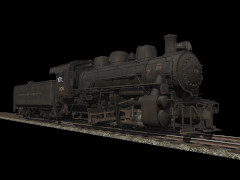
Starting in February 1918, the USRA established committees of locomotive designers and railroad operations staff to design standard locomotives to relieve the power shortage and reduce maintenance costs. The committees intentionally avoided experimental equipment or exotic wheel arrangements; however, the committees were also forward-looking, avoiding antiquated designs which would soon be obsolete. Ultimately, the committees decided on 12 standard designs: two Mikados, two Pacifics, two Santa Fes, two Mountains, two Mallets and two Switchers. Components were standardized between types as much as possible to reduce manufacturing and maintenance costs. Dimensionally, the engines were comparable to examples of each wheel arrangement built in 1916 and 1917. Initial design work was completed in April 1918, with the designs being finalized in June 1918. The first USRA locomotive, a Light Mikado (2-8-2-A) for the Baltimore & Ohio, rolled out of the Baldwin factory in July 1918.
Under the USRA, 1,830 standard locomotives were produced. The 0-6-0-A (this